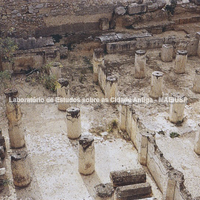
Cistern: as in all cities, water supply is fundamental to life. Water reservoirs were common in many cities.
Bibliography (1)
- Mertens, D.; Città e monumenti dei Greci d’Occidente.
Greece (Megaris)
The polis of Megara Nisaea lay east of the Isthmus of Corinth and was bounded by the Gulf of Corinth to the north, by Mounts Kithairon, Pateras and Kerata to the east – which separate the Megarid from the territory of Attica and Boeotia – by the Saronic Gulf to the south, and by Mount Gerania to the west, which divides the territory of Megara from that of Corinth (Legon, 2005: 463).
Its importance is evident in the social life of two other Greek cities in Sicily: Megara Hyblaea, founded by colonists from Megara Nisaea on the east coast of Sicily, and Selinous, a sub-colony founded by an expedition setting out from Megara Hyblaea, which called on an individual from Megara Nisaea to lead the foundation.
Forms of occupation of the ásty
Cistern: as in all cities, water supply is fundamental to life. Water reservoirs were common in many cities.
Forms of occupation of the khóra
Sanctuary of Zeus Aphesios ("Rain-giver")
This is a sacred area excavated at Marmara, above the Skironian rocks.
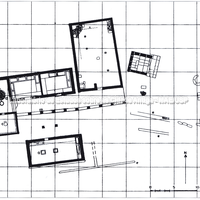
Apart from a few stone blocks, cisterns and terrace walls, nothing of the complex is preserved today. The sanctuary consisted of a courtyard with a small temple in antis and a building complex with several dining rooms attached to it. Photographs of the excavations of the 1900s are the only documentation that can give an idea of the form of the sanctuary (Goette, 2001: 311). Goette gives no information on the dating of the sanctuary.
Forms of occupation of the ásty
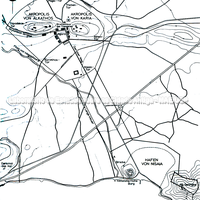
Plan of the polis of Megara and its connection with Nisaea
Today the modern town is part of one of the four districts of Attica. The city lies on the twin hills of Karia and Alkathoos, both 300 metres high. The site and the physical characteristics of the polis are relatively well known. Excavations have identified the agora, stoai, roads and portions of the wall circuits. The fountain house of Theagenes is the best-known surviving monument. The deities worshipped were Apollo, Artemis, Athena, Demeter, Dionysus and Olympian Zeus (Legon, 2005: 464-465; Torelli; Mavrojannis, 2002: 205-206).
According to Torelli (2005), as regards the ideology of religious architectural achievements, it is essential to understand the transposition/arrangement of religious buildings between mother cities and colonies.
The oikistes Pammilos is said to have carried out a meticulous topographical transplant of the sanctuaries of the mother city Megara Nisaea to Selinous, even respecting the separation between the acropolis and the Manuzza plateau, which attests the exceptional character of the placing of the sanctuaries of Selinous. In the case of the sanctuary of Malophoros, there is a correspondence with the arrangement of structures and cult practices dedicated to Nisa in the harbour of Megara Nisaea (Torelli, 2005: 8).
A relationship of transposition or replication of structures and cult practices between mother city and apoikia can be seen in the sanctuary on the acropolis of Selinous. The cults practised in Temple C, Temple D and the Megaron of Selinous are attributed to Apollo, Athena and Demeter respectively, and the same are found on the Alkathoos hill at Megara Nisaea (Veronese, 2006: 519-520).
The sanctuary in the extra-urban area near the harbour at Selinous has been compared with the sanctuary of Hera at Megara Nisaea, and by analogy some authors attribute this temple of the Selinuntine sanctuary to the goddess (Veronese 2006: 505-508), supporting the hypothesis of the transposition/replication of structures of the mother cities in the apoikiai.
At Megara Nisaea Dionysus enjoyed a certain prominence (Coarelli; Torelli, 1984:84). On the eastern hill of Selinous, sanctuaries E, F and G would also correspond to a projection of sanctuaries existing at Megara Nisaea. The temples are aligned a short distance from one another. Temple F is the smallest of the three buildings on the eastern hill and is consecrated to the god Dionysus (Mertens 2010: 78).