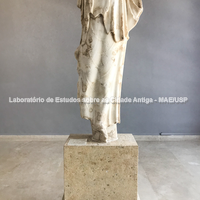
Descending Nike (displayed in the Paros Museum, no. 245), dated to 470 BC, excavated below the Kastro before 1884, above a deep prehistoric level. It was located directly in front of the medieval walls of the castle, which must have taken the place of the ancient walls after the steep topographic drop. It is therefore assumed that the statue fell from the Acropolis. Its importance lies in the fact that it is a rigorous Parian masterpiece, created for a high position, that is, as an acroterion or an anathema on a pillar. Nike (fig. 17) is depicted as a youthful female figure wearing a peplos and sandals on her feet. The head, wings and arms are missing. The head of Nike was turned to the left, her left arm was raised, and she held a garment, which is open at the side. At the front, the peplos clings to the body, which can be seen beneath the thin material. The right leg was suspended in the air, and she has just set her left foot on the ground. Another factor that gives importance to this sculpture is the interpretation of its existence. Rubensohn, for example, saw this Nike as a trophy set up in the centre of the city after the victory of the Parians against the Athenians, but it may also be related to some kind of intervention from outside Paros. Gruben, for example, points out that the political situation after 480 BC, following the violent subjugation of Paros by Themistocles, could explain the creation of a Nike; however, it is more likely not to be a Parian Nike, but one in honour of the Greek victory over the Persians. According to the archaeologist, this would demonstrate the pressure of the Athenians on Paros and on the main temple of the city. (Gruben, 1982, pp. 219-220).
Full-size image restricted
Nausitoo images are intended exclusively for academic research and teaching. To view them at full size, register and accept the Terms of Use, or sign in.