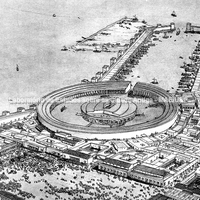
Punic Carthage, sketch by Golvin. Drawing representing a reconstruction of the lower city in the Punic period, based on the present landscape and also using ancient texts and recent archaeological discoveries. In the background is the commercial harbour, formed by a rectangular basin opening onto a small cove. Docks and warehouses occupied this harbour. Anchored in the sea by an artificial landing platform serving as the "choma" reported by ancient authors, behind the commercial harbour, the military harbour was a circular basin whose centre was largely occupied by the Admiralty. It was a secret, fortified harbour surrounded on all sides by a series of galleries that sheltered warships. Around the two basins there were commercial, craft and residential zones, as shown in the foreground, the commercial centre of the agora.
Full-size image restricted
Nausitoo images are intended exclusively for academic research and teaching. To view them at full size, register and accept the Terms of Use, or sign in.