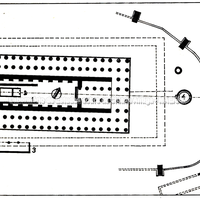
Archaic Didymaion (560–550 BC). Ionic dipteros measuring 38.39 x 85.15 m. The plan shows the Archaic Didymaion drawn within the Hellenistic Didymaion. The unroofed cella (also known as sekos or adyton) is elongated; the roofed pronaos is deep. Within the cella can be seen 1) the temenos of the first Didymaion (end of the 8th or beginning of the 7th century BC); 2) the "naiskos" within the early temenos (520 BC). The statue of Apollo, the work of the sculptor Kanachos of Sikyon, stood in this naiskos. The inner wall surfaces of the cella were decorated with pilasters to form a kind of architectural façade. 3) The recently discovered stoa of 3.60 x 15.50 m is preserved in the south-west corner of the dipteros and was built in the 7th century BC. The outer "peristasis" of the dipteros had 9 columns on the west façade, 8 on the east and 21 on each side. Some of the eastern columns were decorated with reliefs in the manner of those of the "Ephesian" temple. The bases and capitals also resembled the "Ephesian" models; the column shafts were carved with 36 flutes. By using one column fewer on the east side, the interval between the columns in the centre was made wider, thus forming a kind of entrance, as in other Ionic temples. In this way the front was emphasised. 4) A circular altar stands on the axis passing through the middle of the central intercolumniation. The sacred way from Miletus led to the north-east corner of the Didymaion. The east façade of the temple was surrounded by a 3.5 m high wall, parts of which are still standing. It was built in about 550 BC, as indicated by the form of the "kymation" on the upper cornice. The wall supported the front of a platform where offerings were placed. Five flights of steps led up to it at various points. Two stoas, as well as several statues and portable altars, stood on this platform.
Full-size image restricted
Nausitoo images are intended exclusively for academic research and teaching. To view them at full size, register and accept the Terms of Use, or sign in.