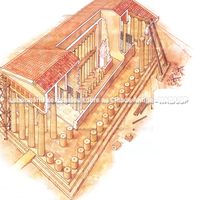
Reconstruction of temple G. The Greek temple with columns around the cella was born during the 8th century BC. Before that, it consisted of a space delimited around a simple structure or a sacred area. The temple was the house of the deity, where its statue was worshipped. The evolution of the temple became increasingly linear and refined, with features such as optical corrections, polychromy and sculptures decorating the frieze and façades. The society of a polis identified itself through the construction of temples and, moreover, temples were signs of identity, especially in the Greek colonies. The temples of Selinous, in number and size, were the concrete image of a great and powerful city. The largest of them was temple G (530–409 BC), shown here in a partial elevation during the construction of its main structures. It was 110.36 m long and 50.10 m wide; the columns were 16.27 m high and 3.41 m in diameter. It was probably dedicated to Zeus.
Full-size image restricted
Nausitoo images are intended exclusively for academic research and teaching. To view them at full size, register and accept the Terms of Use, or sign in.