
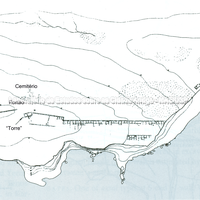
"We do not know the ancient name of this settlement on the island of Rhodes. There the remains of a 300 m length of wall were found, with a stone base a little over a metre thick, no doubt originally carrying a superstructure of unfired brick. These remains extend along a strip of coastal land to the south-west. Except for a section at the western end, the wall is perfectly straight, and against its inner face a row of simple houses had been built, consisting at most of a pair of rooms with a small courtyard in front. At a distance of approximately 25 metres, a second row of houses ran parallel. The main gate was probably where the wall changed direction. Near this change of direction a walled enclosure containing two altars was found, and an adjacent enclosure which may have been the agora. The pottery allows all these structures to be dated no later than 700 BC. Vroulia was only a small town, no doubt subordinate to a larger city, presumably Lindos." (Stillwell, 1976, p. 755)
Bibliography (2)
- Frederiksen, R.; Greek City Walls of the Archaic Period, 900-480 BC (Oxford Monographs on Classical Archaeology)
- Stillwell, R. (ed.); The Princeton Encyclopedia of Classical Sites.