Thera

Greece (Aegean - Cyclades)

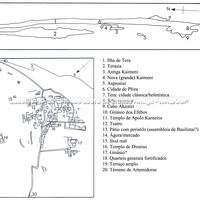
Thera is the Aegean island closest to Crete and belongs to a micro-archipelago of six islands: Thera – also known as Santorini – Therasia, Nea Kameni, Palea Kameni, Aspronisi and Christiana. The first two are inhabited today, the other three are not. The name of the island comes from an ancient epithet, Kalliste ("the most beautiful"), but it is believed that in reality it was so named because of an enormous volcanic eruption in the past, which is thought to have caused tsunamis throughout the Aegean as far as the Levant. The island is also recognised as a colony of Sparta, founded by the oikistes Theras, according to Herodotus and Pausanias.

Several settlements have been located on the island: Oia, of the Archaic period; Eleusis, of the Classical period; and Perissa, corresponding to both periods. The first of them, however, is ancient Thera, in the south-east of the island. Probably founded by Carians in the 3rd millennium BC, it is said to have been absorbed by the Greeks around 1900 BC; Archaic temples have been found at Thera, as well as terraced areas and a Cyclopean wall. In addition, there is a 3rd-century BC theatre and a large number of Hellenistic houses.

Forms of occupation of the ásty

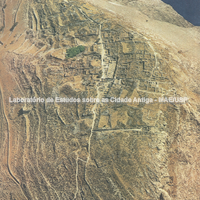
Urban grid: acropolis, block, agora, plateiai, stenopoi, orientation

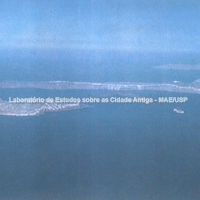
The layout of the territory of Thera, with particular attention to the arrangement of the islands and the location of the original settlement, possibly of post-Mycenaean origin, in the north of the main island. Nevertheless, other small settlements of the Archaic and Classical periods have been discovered, such as Oia, Eleusis and Perissa, for example.

In the urban grid, public buildings can be seen among the remains.
Bibliography (1)
  • Schoder, R. V.; Ancient Greece from the Air.
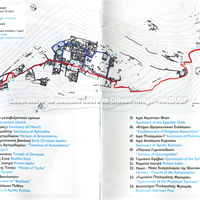
Plan of the city and its main buildings.