Tenos

Greece (Aegean - Cyclades)

Founded by Ionians in the 10th century BC, Tenos lies near the centre of the Cyclades archipelago, north-west of Delos. The island prospered greatly in the Geometric and Archaic periods, retaining some importance in the Classical era.

The first urban settlement on the island is on the hill of Xobourgo, where it remained in the Archaic and Classical periods; around the middle of the 4th century BC the new urban centre was established where the modern town stands today. The site at Xobourgo has remains of a wall and of a temple possibly dedicated to Demeter Thesmophoros, although the main deities of Tenos were Poseidon and Amphitrite, whose main sanctuary lay 2.5 km west of the new urban centre.

Forms of occupation of the khóra

Sacred areas: deposits, temples, shrines, sanctuaries, altars

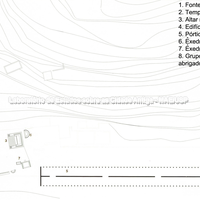
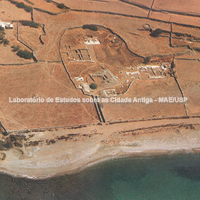
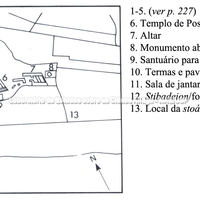
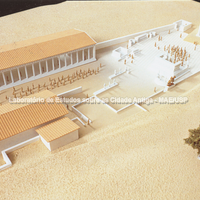
Poseidon and Amphitrite were considered the main deities worshipped on Tenos, since it was believed that storks were sent to the island by the god to help control the snake population there. The sanctuary complex lies isolated along the north-west coast of the modern capital; in antiquity it was 2.5 km from the original settlement on the hill of Xobourgo. Considered an extra-urban sanctuary, it has Doric-style structures as well as decorative motifs going back to the Hellenistic period.
Bibliography (2)
  • Schoder, R. V.; Ancient Greece from the Air.
  • AA.VV.,; L`espace grec. 150 ans de fouilles de l’École française d`Athènes.
Forms of occupation of the ásty

Urban grid: acropolis, block, agora, plateiai, stenopoi, orientation

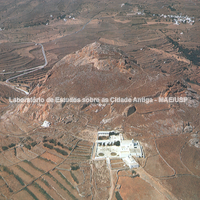
Occupation of the territory of Tenos began on the hill of Xobourgo, now 5 km from the coast of the island; the site prospered especially in the Geometric and Archaic periods, from which the main structures found at the site come. There is evidence of terracing and of construction by cutting into the rock.

Bibliography (1)
  • Schoder, R. V.; Ancient Greece from the Air.

Forms of occupation of the ásty

Walls and position of the gates

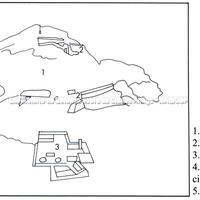
The hill of Xobourgo, with remains of walls, roads, gates and towers, as well as ancient and modern sanctuaries. Over time the defensive structures were reused; the main wall, of Mycenaean origin, 25 m wide and of Cyclopean construction, was rebuilt in the Archaic period, partly by cutting into the rock. Cyclopean construction involves the use of large stone blocks (in the case of Tenos, granite) without mortar – a technique common among the Mycenaeans.

Outside wall A, on terrace AA, tombs of the Geometric period were found.

Bibliography (2)
  • Schoder, R. V.; Ancient Greece from the Air.
  • Frederiksen, R.; Greek City Walls of the Archaic Period, 900-480 BC (Oxford Monographs on Classical Archaeology)