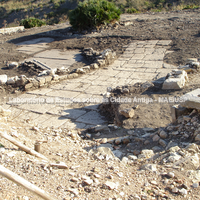
Views of the plain, landscape of the site, general layout of the settlement.
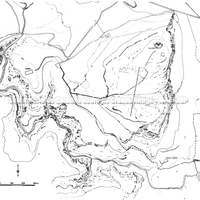 Map of the city (Natoli).
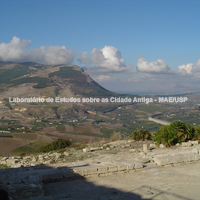 View from the theatre over the plain towards the north.
 General view from the ásty.
Bibliography (1)
- Labeca,; Foto Acervo Labeca
Sicily (North Coast)
The foundation date of Segesta is uncertain. We know that it was an important centre of the Elymians (a people who inhabited Sicily before the arrival of the Greeks). An ally of Carthage, it was besieged by Syracuse in 397 BC and conquered by that city in 307 BC. From the end of the First Punic War, in 241 BC, Segesta passed into the orbit of Rome, with several advantages typical of an allied city. A temple, a theatre and various structures, including an agora and stretches of the wall, have been excavated at Segesta.
Borders
Views of the plain, landscape of the site, general layout of the settlement.
Map of the city (Natoli).View from the theatre over the plain towards the north.General view from the ásty.Forms of occupation of the ásty
The agora is being excavated by the University of Pisa. For the moment it is estimated to have covered an area of 4,000 m², and what is currently being excavated dates from the 3rd century BC, although some areas have revealed lower levels.
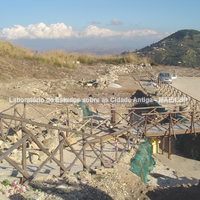 Agora, area under excavation, east 1.
 Agora, area under excavation. North, seen from the east.
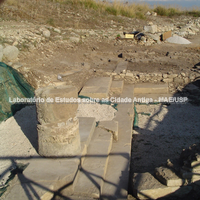 Agora, area under excavation. East 2.
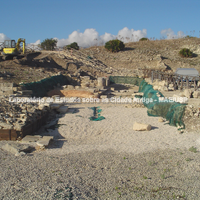 Agora, area under excavation. North, seen from the west.
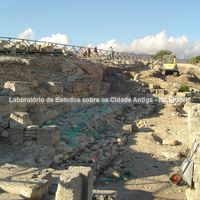 Agora, area under excavation. East 3.
 Plan of the west side. Agora. Explanatory panel at the site, showing the Hellenistic and…
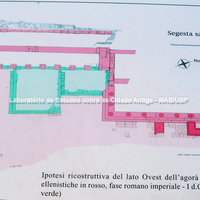 Plan of the west side of the agora, with a reconstruction hypothesis. Hellenistic and…
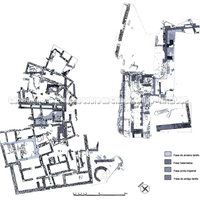 Agora. The building/alteration phases of the agora. (Scuola Normale Superiore di Pisa)
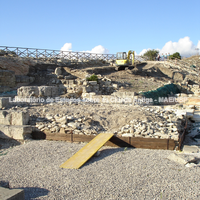 Agora. Area under excavation.
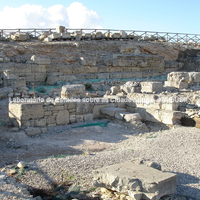 Agora. Area under excavation.
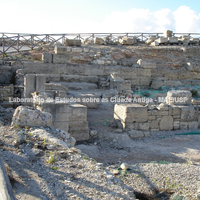 Agora. Area under excavation.
Detail of an ancient pavement of a later period, probably Roman
The theatre of Segesta is set on the northern slope of Monte Barbaro, but it also needed a retaining wall at the corner where the slope did not offer enough support. Its structure is typical of the transition from the Greek to the Roman theatre. A date in the mid-4th century is generally accepted for its construction.
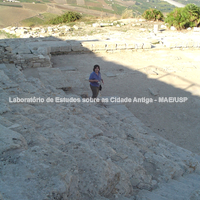 Theatre overlooking the plain.
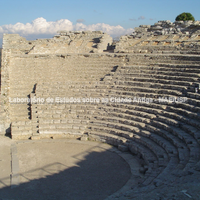 Theatre.
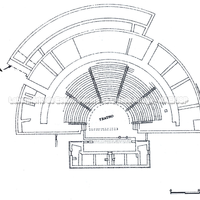 Plan of the theatre.
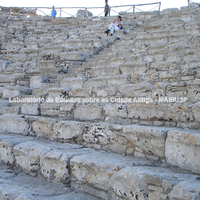 Theatre. Cavea.
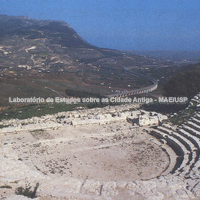 Theatre. Note how it is set in the landscape.
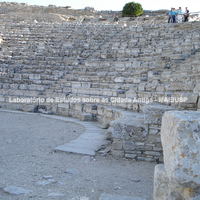 Theatre. Partial view of the cavea.
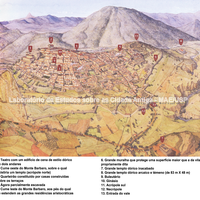 Reconstruction of Segesta based on a few excavated points and aerial photographs.
Macellum (Roman market) in the area of the agora.
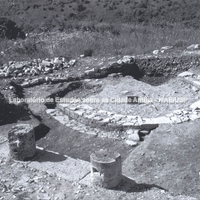 Agora. Area of the macellum (Roman market), from the north-east. (Archive of the Scuola…
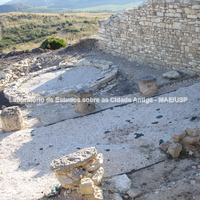 Excavation. Area of the macellum (Roman market), from the north-west.
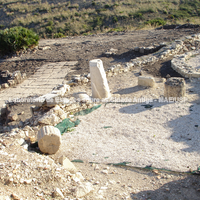 Excavation. Area of the macellum (Roman market), from the north-west.
Segesta is a settlement established on Monte Barbaro, in western Sicily, a few kilometres from the north coast of the island. Monte Barbaro is a limestone massif with two peaks, one 429 m and the other 420 m above sea level. The river Gaggera surrounds the mountain in places and joins the river S. Bartolomeo, which in turn flows into the sea in the Gulf of Castellammare. It is thought that the harbour used by Segesta lay here. From the top of the mountain one can see the whole surrounding territory: the sea and the fertile plains at the foot of the mountain.
Little is known about the urban grid of Segesta. It has been very little excavated. However, aerial photographs seem to show a regular, terraced settlement, probably laid out in the city's heyday between the 6th and 5th centuries.
Some Archaic houses have been excavated on the slopes of Monte Barbaro, some of them cut directly into the rock.
On the southern slope of Monte Barbaro a sanctuary called the "Santuario di Contrada Mango" has been excavated. This sanctuary has a temenos of 47.80 by 83.40 m. Although it is not known to which deity it was dedicated, the building remains and objects found there date it to the 6th–5th century.
Outside the city walls, on the west side and on another hill, an enormous Doric temple was built, dated to 430–420. However, this area was already a place of worship from at least the 6th century, as the excavations attest. It is not known to which deity this temple was dedicated. It should be said that it was never completed.
Inside the walled area, on the northern peak, or the north acropolis as archaeologists call it, a series of buildings was found that may define this area as an eminently public one. The most impressive building for visitors is the famous theatre, which dates from the mid-2nd century, and therefore from the Roman period. A bouleuterion, a small temple and an agora were also found here.
On the southern peak, what would be the south acropolis, residential structures were found.
Map of the ásty and possible reconstruction.
Map of the city (Natoli).Reconstruction of Segesta based on a few excavated points and aerial photographs.Forms of occupation of the ásty
The city – Monte Barbaro – was enclosed by walls from the 5th century. In this wall, which has stretches from the 6th century, 11 square towers and 5 gates have been found. One of these gates, the Porta di Valle, on the west of the mountain, has been extensively excavated. That side was a natural approach to the city, hence the position of the gate. The excavations show that this gate may have been too accessible to enemies as well, and it seems that in the 4th century it was closed and another gate higher up, the Porta di Stazzo, was opened.
A series of alterations up to the 1st century has been identified in this wall.
Map of the city (Natoli).Reconstruction of Segesta based on a few excavated points and aerial photographs.Forms of occupation of the khóra
Leaving through the southern gates in the city walls, there is a road with many rock-cut chapels leading to a magnificent sanctuary at "Contrada Mango". Archaeology confirms that this sanctuary was frequented from the 8th century BC. The structure found belongs to the temenos wall, made of very large blocks decorated on the outside with incisions and enclosing a precinct of approximately 83 x 48 m. Inside, many temple elements were found: triglyphs, column fragments and Doric capitals, possibly of the 6th and 5th centuries BC. Many fragments of Attic pottery with fine inscriptions were also found.
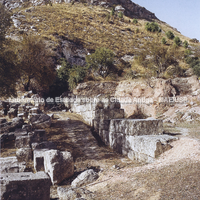 Sanctuary at Contrada Mango. Temenos wall.
 Sanctuary at Contrada Mango, temenos wall, detail.
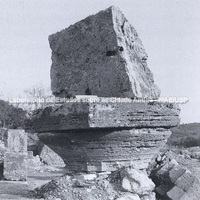 Sanctuary at Contrada Mango, capital.
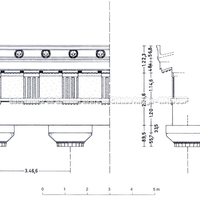 Sanctuary at Contrada Mango, normal entablature. 1:100. M. Schützenberger.
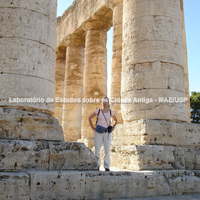 Doric temple. Dimensions/Proportions.
Doric temple. This is the most famous monument of Segesta. Probably built in the second half of the 5th century BC, it remained unfinished, as shown by the lack of fluting on the columns and by the fact that it never had a roof. Nevertheless, it has been standing since antiquity, delighting visitors. Goethe's visit to Segesta and his description of the experience are famous. The cult to which this temple was dedicated is unknown.
It should be noted, however, that this is an extra-urban temple, positioned outside the walls, although very close to them, on the west side of the settlement.
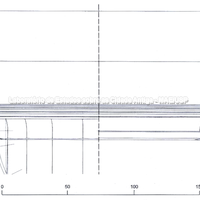 Doric temple, capital (1:20. M. Schützenberger)
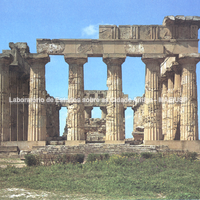 Doric temple.
 Segesta: archaeological area with the Doric temple. (Mario Matteucci)
 Plan of the Doric temple, about 430–420 BC. (Mertens 1984)
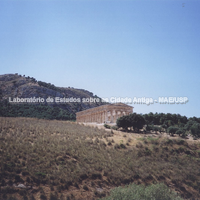 View of the Doric temple, 430 BC.
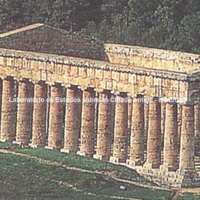 Doric temple, 430 BC.
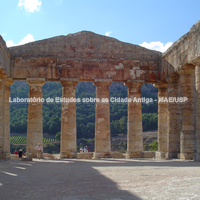 Doric temple – view of the Naos – east–west direction.
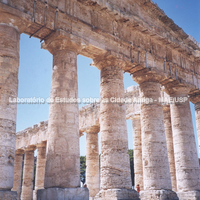 Doric temple, 430 BC, façade.
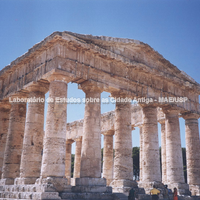 Doric temple, 430 BC, façade.
 Doric temple, 430 BC, interior.
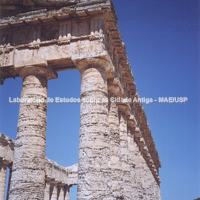 Doric temple, 430 BC, rear.
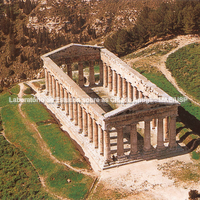 Doric temple, aerial view.
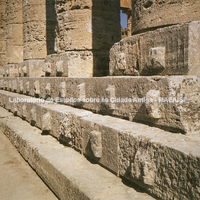 Doric temple. The foundation course with its slight curvature and the lifting bosses…
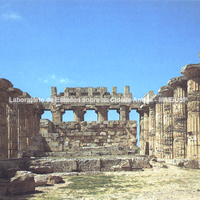 East side of the peristyle of the Doric temple.
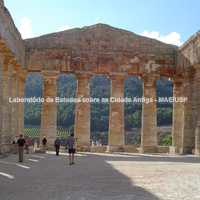 Temple – view of the Naos – east–west direction.
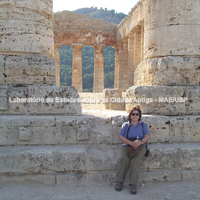 Temple, architectural detail. Column, stylobate. Elaine.
 The Doric temple in the landscape, seen from the east.
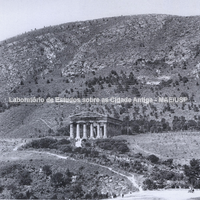 Doric temple seen from the east.
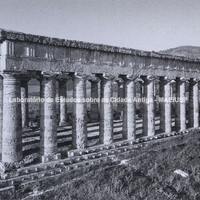 Doric temple, seen from the north-east.
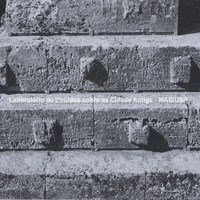 Doric temple, detail of the crepidoma.
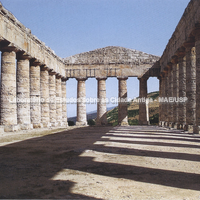 Interior of the great temple seen from the north-west.
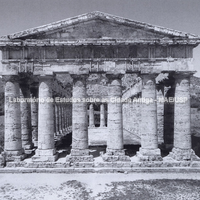 Doric temple, east front.
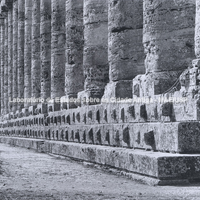 Doric temple, south flank; curvature for optical correction.
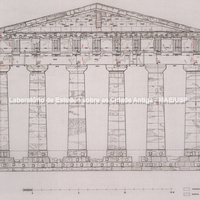 Great temple, east front. M. Schützenberger.
 Doric temple, elevation with metrology. M. Schützenberger.
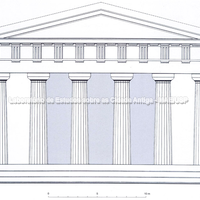 Doric temple, reconstructed elevation. M. Schützenberger.
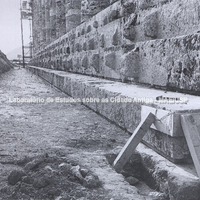 Doric temple, north side; curvature for optical correction.
 Doric temple, south-west corner.
 Doric temple, palmette at the corner of the geison.
Reconstructions
Images of various reconstructions.
Sanctuary at Contrada Mango, normal entablature. 1:100. M. Schützenberger.Great temple, east front. M. Schützenberger.Doric temple, elevation with metrology. M. Schützenberger.Doric temple, reconstructed elevation. M. Schützenberger.Doric temple, capital (1:20. M. Schützenberger)Reconstruction of Segesta based on a few excavated points and aerial photographs.Building techniques
Architectural details of the great Doric temple and of remains of a temple at Contrada Mango.
Sanctuary at Contrada Mango, capital.Doric temple, south-west corner.Doric temple, palmette at the corner of the geison.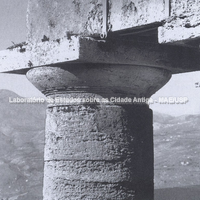 Doric temple, north-west corner capital.
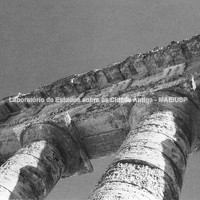 Doric temple. Unfluted columns and limestone architrave. Last quarter of the 5th century…