
The whole hinterland of southern Calabria, with coastlines on the Tyrrhenian and Ionian Seas, was disputed between the two cities of Rhegion and Locri, which founded military outposts and other settlements such as Metauros, Hipponion and Medma. This whole region had indigenous populations which, influenced by the Greeks, joined or supported one polis or another.
Rhegion is an apoikia founded by Chalcis, probably in the 8th century BC. Textual records also point to the participation of Euboeans in this foundation, and of Messenians fleeing the First Messenian War in the Peloponnese. Rhegion lay on the banks of the river Halex, and its territory bordered Locri on the Ionian Sea and Metauros on the Tyrrhenian Sea. Rhegion was one of the few settlements in a fertile location in Aspromonte, and there are indications that these lands were exploited from the 7th century BC. At Serro di Tavola there is a walled settlement interpreted as a phroúrion of Rhegion controlling the routes to the interior and to the Tyrrhenian. The extra-urban cult of Heracles is attested near Metauros, as is the cult of Demeter at Griso-Saline Ioniche. The territory of Rhegion was estimated by Vallet at c. 1,000 to 1,300 km². But Rhegion was responsible for the foundation of Pyxous on the Tyrrhenian, and therefore its area of influence – always in competition with Locri – must have been very large. (Hansen, 2004, 291)
Forms of occupation of the khóra
Structures marking the extent of the territory
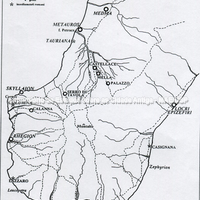
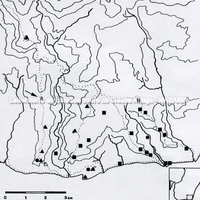
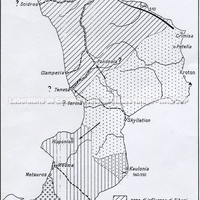
Metauros lies at the source of the river Metauros/Petrace; it was a foundation of Rhegion intended to counter Locri, which had founded Medma and Hipponion. But Metauros passed into the orbit of Locri in the 6th century BC (Gioia Tauro). At Monacelli monumental structures of a sacred area were found that connect the site with Locri, very similar to the temple of Marasà at Locri and dated to the mid-6th century BC. At Terre della Chiesa too there are strong indications of Locrian influence.
Medma and Hipponion had the structure of a polis, while Metauros was more indigenous and had the structure of a trading post (emporion). According to specialists, Metauros remained an area disputed between these two poleis in antiquity.
Bibliography (2)
- Lombardo, M.; Greci e indigeni in Calabria: aspetti e problemi dei rapporti economici e sociali
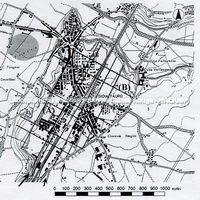
- Cordiano, G.; Accardo, S.; Ricerche storico-topografiche sulle aree confinarie dell'antica chora di Rhegion.ica chora di Rhegion.