Nichoria

Greece (Messenia)

A settlement in Messenia occupied from the early centuries of the 2nd millennium; in the Mycenaean era it was a residential centre in the orbit of the palace of Pylos, though keeping its independence. It enjoyed a privileged location: on high, protected ground about 2 km from the Messenian Gulf, at the confluence of land routes leading to the southern Peloponnese. It had rivers suitable for an irrigation system which, combined with a significant rainy season, made it possible to grow flax, an export product controlled by the palatial system. With the collapse of that system Nichoria remained a small local redistributive centre and, after a brief abandonment around 1200, resumed the growth that produced, between 975 and 850, a community of about 200 people living in small apsidal houses grouped around a large structure about 10.5 m long. This pattern of occupation continued until the mid-8th century, when it was destroyed by fire.

Forms of occupation of the ásty

Residential areas

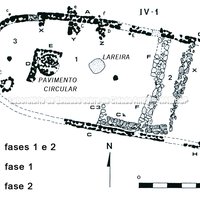
For Mazarakis Ainian, "Unit IV-1" would have been a "Chieftain's House", a place combining political, religious and economic functions. His interpretation is based on its larger size than the surrounding houses, its prominent position and the finds inside.
"Unit IV-1" had two building phases: 1a, dated to the 10th century, and 1b, dated to the second half of the 9th century BC; at the end of that century it was destroyed and would have been replaced by "Unit IV-5".

Bibliography (1)
  • Ainian, A. J. M.; Early Greek Temples: Their Origin and Function.
Forms of occupation of the ásty

Sacred areas: deposits, temples, shrines, sanctuaries, altars

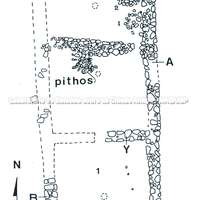
The building called "Unit IV-5" by the archaeologists is one of the two main buildings at the site of Nichoria; the other was called "Unit IV-1" and was destroyed towards the end of the 9th century, when "Unit IV-5" was built to the west of it. Its dimensions are c. 20.20 x 5.50 m, oriented north, and the proposed date is c. 800–750 BC. For Mazarakis Ainian, "Unit IV-5" would have been a "Chieftain's House", a place combining political, religious and economic functions; the same interpretation would apply to "Unit IV-1".

Bibliography (1)
  • Ainian, A. J. M.; Early Greek Temples: Their Origin and Function.