Melos

Greece (Aegean - Cyclades)

Despite the production and trade of obsidian in the territory of Melos, the first settlement on the island, Phylakopi, arose in the Bronze Age, with the decline in the use of obsidian tools. Traces of a Mycenaean population have been found at the site; later it was abandoned and a new site was occupied by Dorian peoples from Laconia. Melos was mentioned by Thucydides in his account of the Peloponnesian War, in which the island remained neutral despite its ties with Sparta, and for this reason was taken by the Athenians. At the end of the war, with the defeat of Athens, Sparta returned the island to the Melians.
Strabo, citing Artemidorus, places Melos among the Cyclades. The Melians are considered colonists from Laconia, and the Melians themselves believed they had been the first settlers 700 years before the Athenian attack in 416/415 BC (Hansen; Nielsen 2004: 759).
"The urban centre of Melos must have been fortified by 424, when the Athenians under Nicias attacked the island, but the walls mentioned by Thucydides are described as the work of the Athenians as part of their operations (...); the agora described by Thucydides in the same context (5,115,4) does not refer to the agora of the Melians but to a military agora serving the besieging Athenians." (Hansen; Nielsen 2004: 759).
The hinterland of Melos was apparently occupied by a considerable number of settlements, some large enough to be considered villages; the urban centre reached its maximum size of 19 ha during the Classical period, which has been interpreted as nucleation, perhaps in response to the Athenian conquest in 416/15 BC (Hansen; Nielsen 2004: 759).

Forms of occupation of the ásty

Urban grid: acropolis, block, agora, plateiai, stenopoi, orientation

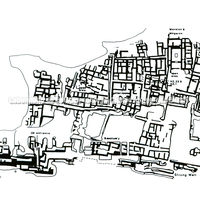
The settlement of Phylakopi, one of the main centres of the island of Melos, and the organisation of its urban grid, highlighting the walls and gates and the location of some buildings. At Phylakopi Colin Renfrew excavated a small Mycenaean shrine, recovering religious artefacts such as the "Lady of Phylakopi", a wheel-made female figurine, and bronze male figurines.
Bibliography (1)
  • Rathje, A. (ed.); Andersen, H. D. (ed.); Horsnæs, H. W. (ed.); Houby-Nielsen, S. (ed.); Urbanization in the Mediterranean in the 9th to 6th Centuries BC.
Borders

Natural features: rivers, topography, sea

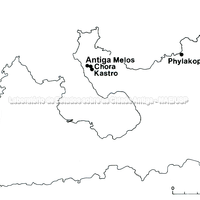
On Melos, the patterns of occupation and distribution of settlements across the island show a long continuity from the Bronze Age to the Hellenistic period. Melos played an important role in the contacts of the mainland Greeks with the Greek and non-Greek settlements on the coast of Asia Minor.

Bibliography (1)
  • Rathje, A. (ed.); Andersen, H. D. (ed.); Horsnæs, H. W. (ed.); Houby-Nielsen, S. (ed.); Urbanization in the Mediterranean in the 9th to 6th Centuries BC.