Medma

Italy (South) (Bruttium)

Medma is a polis founded by Locri, whose territory bordered on it. Archaeological evidence points to a foundation in the 7th century. The scant evidence shows a varied relationship with its mother city. The foundation of Medma (and Hipponion) was the result of the expansion of Locri across Aspromonte through the Mesima valley to gain access to the Tyrrhenian Sea, so as to avoid the Strait of Messina, controlled by Rhegion and Messana in Sicily.
Studies of the territory have revealed Greek influence from the end of the 7th century. The khóra of Medma lay in the Rosarno valley and on the lower slopes of Aspromonte, the crest of these hills dividing Medma from the territory of Locri; in all, the territory measured about 100 km². According to Strabo (VI. 1.5), Medma had a harbour called Emporion, whose location is unknown, although some place it at Nicotera.
The alliance between Locri, Hipponion and Medma is attested in antiquity by several written sources. On the other hand, Thucydides suggests that Hipponion and Medma were allied against Locri around 422.
In 396, Dionysius I of Syracuse relocated 4,000 inhabitants of Medma to Messana. (Hansen, 2004:278)

Museum

Archaeological object

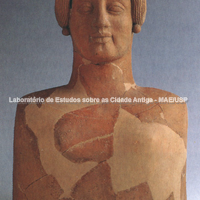
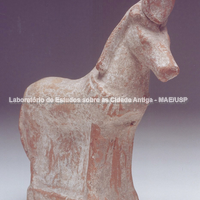
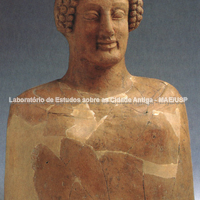
Group of terracottas. Like Locri, Medma has an abundant production of terracotta objects, many of them connected with the cult of Demeter and above all Persephone. MAE holds several of these objects.
Bibliography (2)
  • MAE, L. d. F. d.; Foto Acervo MAE
  • Carratelli, G. P. (ed.); The Greek world: art and civilization in Magna Graecia and Sicily.
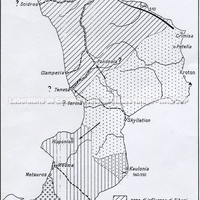
Forms of occupation of the khóra

Structures marking the extent of the territory

The whole hinterland of southern Calabria, with coastlines on the Tyrrhenian and Ionian Seas, was disputed between the various Greek cities established there: Rhegion, Locri, Kaulonia, Croton, Sybaris. This whole region had indigenous populations which, influenced by the Greeks, joined or supported one polis or another.

Bibliography (1)
  • Lombardo, M.; Greci e indigeni in Calabria: aspetti e problemi dei rapporti economici e sociali

Forms of occupation of the ásty

Sacred areas: deposits, temples, shrines, sanctuaries, altars

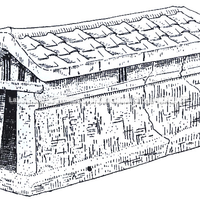
Models of temples and houses are common in the Archaic period in the Greek world. This temple model, from Medma, is now in the Museum of Reggio Calabria.

Bibliography (1)
  • Hellmann, M.; L’ Architecture Grecque. 1. Les principes de la construction.