Istria

Black Sea (Black Sea)

"The river Ister (Danube) then flows freely through Europe and ends its course in the Euxine Pontus, at Istria, which is inhabited by Milesian colonists" (Hdt. 2.33). It is therefore believed that the city was founded by Miletus in 657 BC. Istria itself is said to have founded other apoikiai on the Black Sea, such as Orgame, Nikonion and Istrianon Limen.
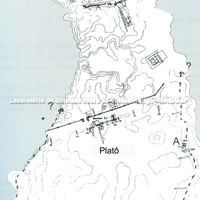
Istria lies near the village of Istria, in present-day Romania. Archaeology has uncovered in the area an acropolis with a temenos dedicated to Athena and the remains of a wall, both from the 6th century BC. There are also remains of a Classical wall that was destroyed at the end of the 4th century BC, probably by Lysimachus. The Archaic wall already enclosed an area of 60 ha, which included the temenos of Athena on the acropolis and the civil settlement in the western part of the city.
The foundation of Istria was a product of the expansion of the Greeks into the Black Sea, which led to the occupation of cereal-producing areas.

Relationship between ásty and khóra

Structures between ásty and khóra: walls, necropoleis, sanctuaries.

Map of Istria highlighting the acropolis and showing the walls found; the dotted line shows a hypothetical reconstruction of the walled area.
Bibliography (1)
  • Frederiksen, R.; Greek City Walls of the Archaic Period, 900-480 BC (Oxford Monographs on Classical Archaeology)
Borders

Natural features: rivers, topography, sea

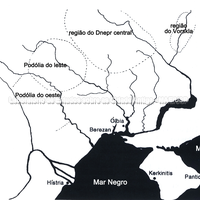
Location of Istria with the other Greek settlements nearby occupying the shores of the Black Sea. The map shows the density of occupation by Greek foundations.

Bibliography (1)
  • Solovyov, S. L.; Ancient Berezan: The Architecture, History and Culture of the First Greek Colony in the Northern Black Sea.