Euesperides

North Africa (Libya)

Euesperides received this name because it was the westernmost of the Greek cities founded in the region called Cyrenaica. Because it lay near a lagoon, which brought a degree of fertility to the area and formed a kind of oasis in the semi-arid environment of the coast of the Gulf of Sirte, its name also recalls the mythological Garden of the Hesperides.
It is not known exactly when the city was founded, nor whether its colonists came from Cyrene or from Barke. Pottery finds date the earliest foundations to the 6th century BC, and in the literary sources the first mention of the city is in Herodotus (IV, 204), in the context of the Persian expedition to Libya around 515 BC.
The city developed in two phases: first, in the 6th century BC, in the northern part of the site, where Sidi Abeid stands today; and later to the south, completed by the 4th century BC, which included the extension of the 6th-century BC wall and the construction of the agora at the centre of a residential area laid out on a regular plan.
In the 3rd century BC, probably because of the flooding of the area between the city and the harbour, its inhabitants moved to a site 3 km west of Euesperides. It was then refounded under the name of Berenike (Steph. Byz. 164, 6–9), probably in honour of Berenike II, daughter of Magas, king of Cyrenaica, who in 258 BC married Ptolemy III, when Cyrenaica was annexed to Egypt (Justin XXVI, 3).

Forms of occupation of the ásty

Urban grid: acropolis, block, agora, plateiai, stenopoi, orientation

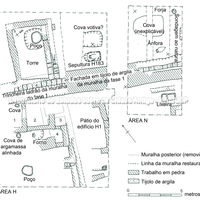
In areas H and N remains of walls and fortifications have been identified. A building inside the wall, dated to the 6th century BC and built on the same axis as the wall, gives a date around the 6th century BC, or even earlier, in the 7th century BC, for the construction of the wall circuit of Euesperides.
Bibliography (1)
  • Frederiksen, R.; Greek City Walls of the Archaic Period, 900-480 BC (Oxford Monographs on Classical Archaeology)
Forms of occupation of the ásty

Walls and position of the gates

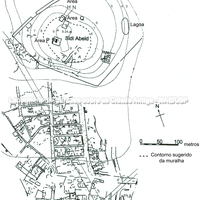
On the basis of the remains found in the north-eastern part of the site now known as Sidi Abeid, a hypothetical line for the wall has been proposed (shown dashed in the image), which is estimated to have enclosed an area of 210 m² in the 4th century BC.

Bibliography (1)
  • Frederiksen, R.; Greek City Walls of the Archaic Period, 900-480 BC (Oxford Monographs on Classical Archaeology)