Kolophon

Asia Minor (Ionia)

One of the oldest and most important cities of Ionia. Its wealth came mainly from the fertility of the land and the seafaring skills of its inhabitants, most of whom were rich and lived luxuriously. In addition, they were known as warriors and horsemen in the 8th and 7th centuries BC. Nevertheless the city fell successively under the rule of Persians and Lydians until, in the second half of the 6th century BC, it passed definitively into Persian hands. The only archaeological evidence remaining from Kolophon, despite its period of opulence in the 7th and 6th centuries BC, is a temple at Klaros. During the Roman period the city remained independent.
The settlement occupied an area formed by three mountains and the valleys between them. The area occupied by the urban centre was triangular and measured 1 km². The walls were fortified by twelve semicircular towers and must have been built at the end of the 4th century BC. The settlement of the Archaic period, on the other hand, has been identified on a hill overlooking the south-western plain at a height of 200 metres.

migration

images from the old database

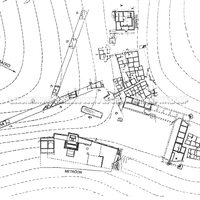
The ruins found at Kolophon are not very well preserved. The wall, along which 12 towers were distributed, is thought to have been built at the end of the 4th century BC. The initial settlement was founded on a hill 200 m high overlooking the south-western plain. Some of the ruins are on the hills to the north, and some important architectural remains have been identified in the excavations carried out by the American School at Athens. They include remains of streets and houses, a stoa built in the 4th century BC and the temple of Demeter Antaia. In the stoa, spaces for official business and shops have been identified.
Bibliography (1)
  • Akurgal, E.; Ancient Civilizations and Ruins of Turkey.