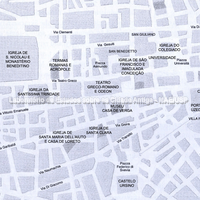
Plan of the ásty showing the road axes and the main buildings.
Bibliography (1)
- Longo, F.; Jannelli, L.; Cerchiai, L.; The Greek Cities of Magna Graecia and Sicily.
Sicily (East Coast)
Catania was founded almost at the same time as Leontinoi by colonists from Chalcis, who thereby completed the last stage of their expansion project, aimed at controlling – mainly commercially – the north-eastern tip of Sicily. The site chosen for the settlement was a very fertile plain, a fact known and remarked on by the ancients. Archaeologically speaking, very little remains of the ancient city, mainly because of volcanic eruptions and continuous occupation up to the present day. The Greek city is known to have occupied a well-protected hill west of the centre of the modern city. Catania occupied a privileged territory at the foot of Mount Etna, in an irrigated zone near a watercourse, with a natural anchorage. Moreover, because of its strategic position, Catania played a leading role in regional commercial traffic.
Forms of occupation of the ásty
Plan of the ásty showing the road axes and the main buildings.
Reconstructions
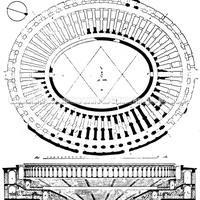
Illustrative reconstruction of the Roman amphitheatre
Research methodology
Graphic display of the distribution of places of worship of different deities. At Catania the distribution of sanctuaries in the territory can be attested within a radius of 30 km, with the point of maximum penetration at 60 km. There is not a great deal of data allowing many relationships to be established between the position of the sanctuaries and the relief, but most of the sanctuaries found were built in low-lying places, at approximately 400 metres. However, compared with other nearby cities, at Catania it has been possible to attest a greater articulation with the deities present.
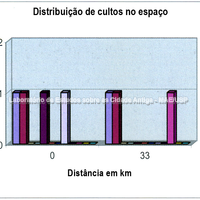 Catania. Graphic display of the relationship between the places of worship and the…
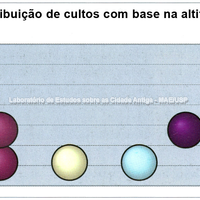 Catania. Graphic display of the relationship between the individual cults and the…
Museum
Votive statuettes of the Archaic period, dedicated first to Zeus and Hera and later to Demeter and Kore. These statuettes come from Chios, which shows that Catania was one of the (few) cities that traded with this small island.
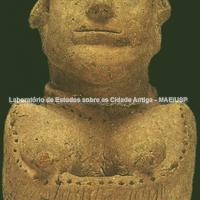 Clay bust of a goddess – Plain of Catania – first half of the 5th century BC – Adrano…
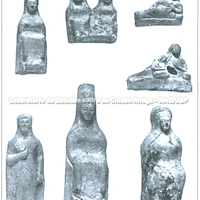 Archaic clay statuettes from the Piazza San Francesco deposit (after Rizza 1960, p. 259…
Forms of occupation of the khóra
Area of Chalcidian expansion showing properties in the khóra and indigenous settlements. Information on the period of Greek occupation is scarce because of the lack of archaeological remains. Note the indigenous settlements under the influence of Catania: Mendolito, Agyrion and Assoro.
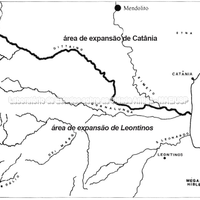 Area of Chalcidian expansion, highlighting the site of Mendolito. Modified after Procelli…
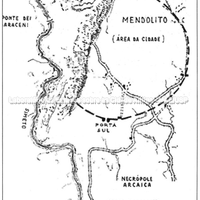 Plan of the Hellenised indigenous centre of Mendolito (after "BdA" 1966).
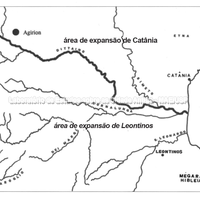 Area of Chalcidian expansion, highlighting the site of Agyrion (after Procelli 1989)
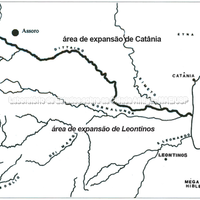 Area of Chalcidian expansion, highlighting the site of Assoro (after Procelli 1989)