Asine

Greece (Argolid)

Asine, an important settlement in the Argolid, was occupied from prehistoric times and completely destroyed by Argos c. 710 BC, according to Pausanias. The author describes the departure of the inhabitants of Asine for Messenia, where they settled at New Asine, today called Korone (2.36.4-5; 3.7.4; 4.14.3). Archaeology has corroborated Pausanias' account, showing signs of an abrupt abandonment of the whole area during the 8th century BC. Archaeological evidence shows it to have been an important settlement especially in the Submycenaean period and the Early Iron Age. Asine was built around two acropoleis and had a good harbour on the Argolic Gulf, as well as an agricultural plain of about 4 km², which made it independent of the Argive plain for food resources. Defensive structures (walls) and apsidal houses similar to those of Mycenae and Argos survive. The Argives destroyed Asine in their quest to dominate the Argive plain, and the site was only effectively reoccupied in the Hellenistic period.

Forms of occupation of the ásty

Walls and position of the gates

General plan of the site and of the wall circuit with the suggested outline (dotted). "At Asine, excavations divided the area of the archaeological site into numbered plots starting from the Barbouna Hill, where the rectangular Archaic Temple of Apollo Pythaeus stands. East of the Barbouna hill, in the Karmaniola plot, remains of apsidal structures were revealed: buildings C and D. In the area south-east of the temple of Apollo, in the Kapsorakhis plot, remains of an apsidal building were also found, Building S" (Diogo de Souza, C. 2005: 122)

Bibliography (1)
  • Frederiksen, R.; Greek City Walls of the Archaic Period, 900-480 BC (Oxford Monographs on Classical Archaeology)
Forms of occupation of the ásty

Sacred areas: deposits, temples, shrines, sanctuaries, altars

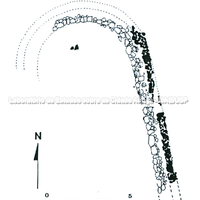
Wall remains of an apsidal building – Building C – of the Protogeometric period, Karmaniola site. "The Karmaniola plot lies south-east of the Barbouna Hill in a lower area of the site of Asine, called the 'Lower Town', approximately 600 m from the Temple of Apollo on top of the hill. The two apsidal buildings in this area, Buildings C and D, are contiguous." (Diogo de Souza, C. 2005:122)
Dimensions: 11.50/12 m long by 7.80/8 m wide for the external bases, and 11/11.50 m long and 6.62 m wide for the innermost foundations (Diogo de Souza, C. 2005: 122-123)
Associated material: pottery, hearth. In the external area, funerary structures, a pithos with pottery remains and animal bones (Diogo de Souza, C. 2005: 123-124)
_

Bibliography (1)
  • Ainian, A. J. M.; Early Greek Temples: Their Origin and Function.