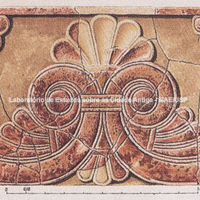
Akrai

Sicily (East)

According to Thucydides (IV, 5,3), Akrai was the oldest sub-colony of Syracuse, founded in 664 BC, a date confirmed by archaeology. The polis lies at an extremely strategic point, an obligatory passage for anyone leaving Syracuse for the Sikel regions of the interior or for the Greek cities of the south coast. It was a city intended to protect Syracuse.
It was established at the westernmost point of the great plateau behind Syracuse, bounded by the river Anapo to the north and the Tellaro to the south. Akrai was an apoikia entirely dependent on its mother city. (under construction)

Forms of occupation of the ásty

Urban grid: acropolis, block, agora, plateiai, stenopoi, orientation

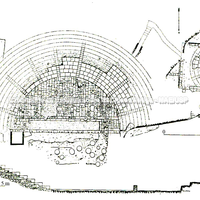
The theatre complex dates from the 3rd century BC and is associated with a bouleuterion. Although the plan does not show it fully, the theatre has a semicircular cavea (place for the spectators), and the orchestra is also semicircular according to the archaeological data, bringing it close in shape to the theatre of Metapontum in southern Italy. It is thought that the agora lay near these two civic buildings. Three ancient wells, no doubt for water supply, were also found in this area.
Bibliography (3)
  • Florenzano, M. B. B.; Relatório científico de viagem ao exterior
  • Coarelli, F.; Torelli, M.; Sicilia - Guide Archeologiche Laterza.
  • Longo, F.; Jannelli, L.; Cerchiai, L.; The Greek Cities of Magna Graecia and Sicily.

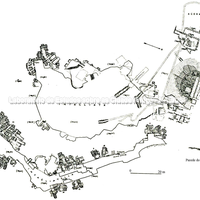
The residential area of Akrai occupied a plateau 770 m above sea level and covered 35 hectares. There was room here only for the dwellings of a few thousand people. There are indications of walls around this small plateau, and an inscription recording the Selinous gate has been found. An eastern gate is therefore assumed to have existed. The remains found date from the Hellenistic and Roman periods. However, it is possible to hypothesise that the urban grid was built over the city's original grid.
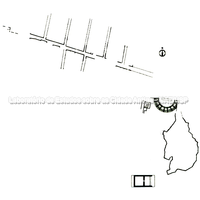
The street layout is not orthogonal: there is a central plateia 4 m wide, from which other small streets 3 m wide branch off; these are not quite perpendicular and do not cross the plateia from one side to the other – there is a slight offset. The blocks are roughly 27 m wide. The streets are paved only at the crossings.

Bibliography (3)
  • Florenzano, M. B. B.; Relatório científico de viagem ao exterior
  • Coarelli, F.; Torelli, M.; Sicilia - Guide Archeologiche Laterza.
  • Longo, F.; Jannelli, L.; Cerchiai, L.; The Greek Cities of Magna Graecia and Sicily.
Forms of occupation of the khóra

Funerary spaces: necropoleis, scattered burials

On the east side of the theatre there is a rocky outcrop (Latomie in Italian), full of caves that were used as places of worship and, in the Early Christian period, as a necropolis. They are traditionally called Intagliata and Intagliatella. In the 4th and 3rd centuries BC heroised dead were worshipped here, as revealed by the numerous votive reliefs found.

Bibliography (3)
  • Florenzano, M. B. B.; Relatório científico de viagem ao exterior
  • Coarelli, F.; Torelli, M.; Sicilia - Guide Archeologiche Laterza.
  • Longo, F.; Jannelli, L.; Cerchiai, L.; The Greek Cities of Magna Graecia and Sicily.
Forms of occupation of the ásty

Sacred areas: deposits, temples, shrines, sanctuaries, altars

On the hill south of the theatre an Archaic temple (6th century BC) was excavated, perhaps dedicated to Aphrodite and Artemis. It is hypothesised that it stood on the acropolis of the settlement. Inscriptions attesting the cult of Zeus Akraios, the nymphs and Kore have been found.

Bibliography (3)
  • Mertens, D.; Città e monumenti dei Greci d’Occidente.
  • Coarelli, F.; Torelli, M.; Sicilia - Guide Archeologiche Laterza.
  • Longo, F.; Jannelli, L.; Cerchiai, L.; The Greek Cities of Magna Graecia and Sicily.