Abdera

Thrace (Thrace)

Abdera was founded by Teos in 544 BC as a coastal city on the left bank of the river Nestos, across the strait opposite Thasos. It lay in a marshy area frequently flooded by the river. The territory was fertile and therefore intensively farmed. Fishing was also plentiful, and Abdera had one of the only natural anchorages in the region. All this helped Abdera to become rapidly an economic power as well as the largest city on the northern coast of the Aegean. Abdera maintained close ties with its mother city until Roman times, even sharing religious festivals. Although the region has undergone dramatic geomorphological changes from antiquity to the present day, it has been possible to recover remains from Classical and even Archaic times, such as fortifications in the harbour area, the remains of an important public building, houses and a cemetery.

Borders

Markers: horoi, phrouria, sanctuaries, harbours.

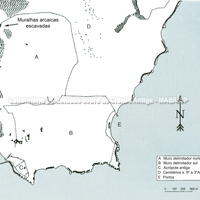
General plan of the site. We can see the spatial relationships between the cemeteries, walls, agora and harbour. The space of the living is separated from that of the dead by a wall that places the necropoleis outside the ásty. Another relationship we notice is the proximity between the commercial areas, the agora and the harbour.
Bibliography (1)
  • Frederiksen, R.; Greek City Walls of the Archaic Period, 900-480 BC (Oxford Monographs on Classical Archaeology)
Forms of occupation of the ásty

Residential areas

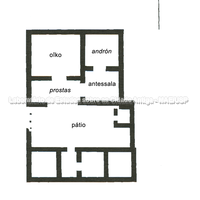
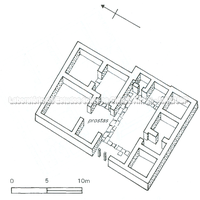
Plan and axonometric reconstruction of House C (based on Lazaridis 1952, figure 27). These two house plans show the typical model of the Greek house, with an inner courtyard linking the various areas of the house. What is marked as prostas is an open veranda giving access to the more secluded area of the house. The andron with its "anteroom" is the most public place, where men generally received visitors. Although this was a strictly male part of the house, it is thought that it was also used by the women of the household when there were no visitors, since many female objects are found during excavations in this part of the residence.

Bibliography (1)
  • Nevett, L. C.; House and society in the ancient Greek world.